Goodreads
|
#App revamp
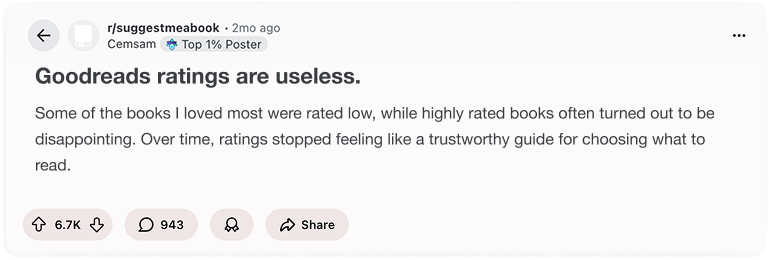
Can you really trust a book’s star rating?
Duration
8 Weeks
Theme
Context Recovery, Task Resumption
Role
UX/UI Design, User Research, Prototyping, Usability Test
Tools
Figma, Figjam, Figma Make, Stitch
PROJECT OVERVIEW
Goodreads is a global platform used by millions, yet it faces a critical trust crisis due to review bombing and fake accounts, which can lead to user churn. This project moves beyond UI enhancements to restructure Information Architecture, protecting the platform’s most vital asset, data integrity. By ensuring fair and transparent book discovery, I revamped the experience to reduce user attrition and secure long term business sustainability through a healthier community ecosystem.
FINAL DESIGN
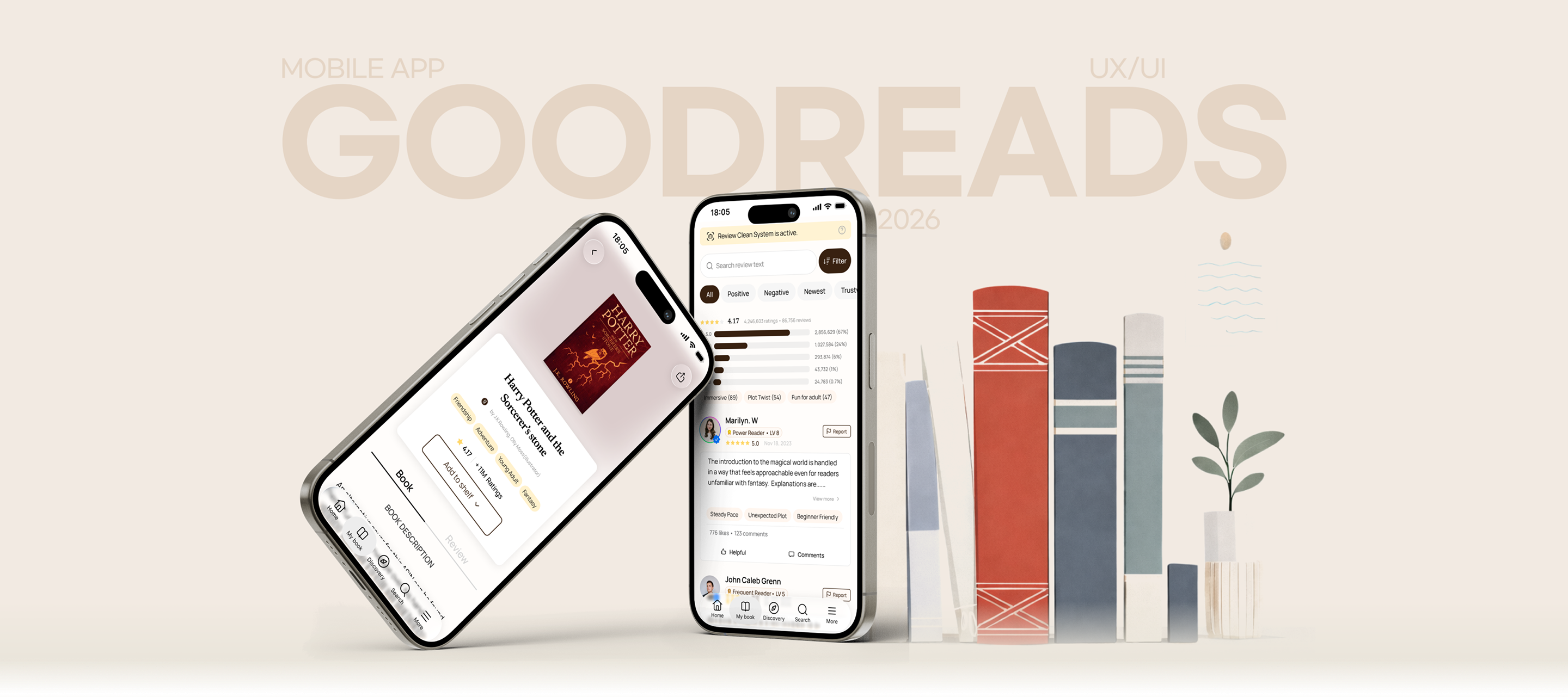
Making book reviews feel more trustworthy, fair, and useful
1. BOOK EXPLORE
A review flow that reduces rating bias
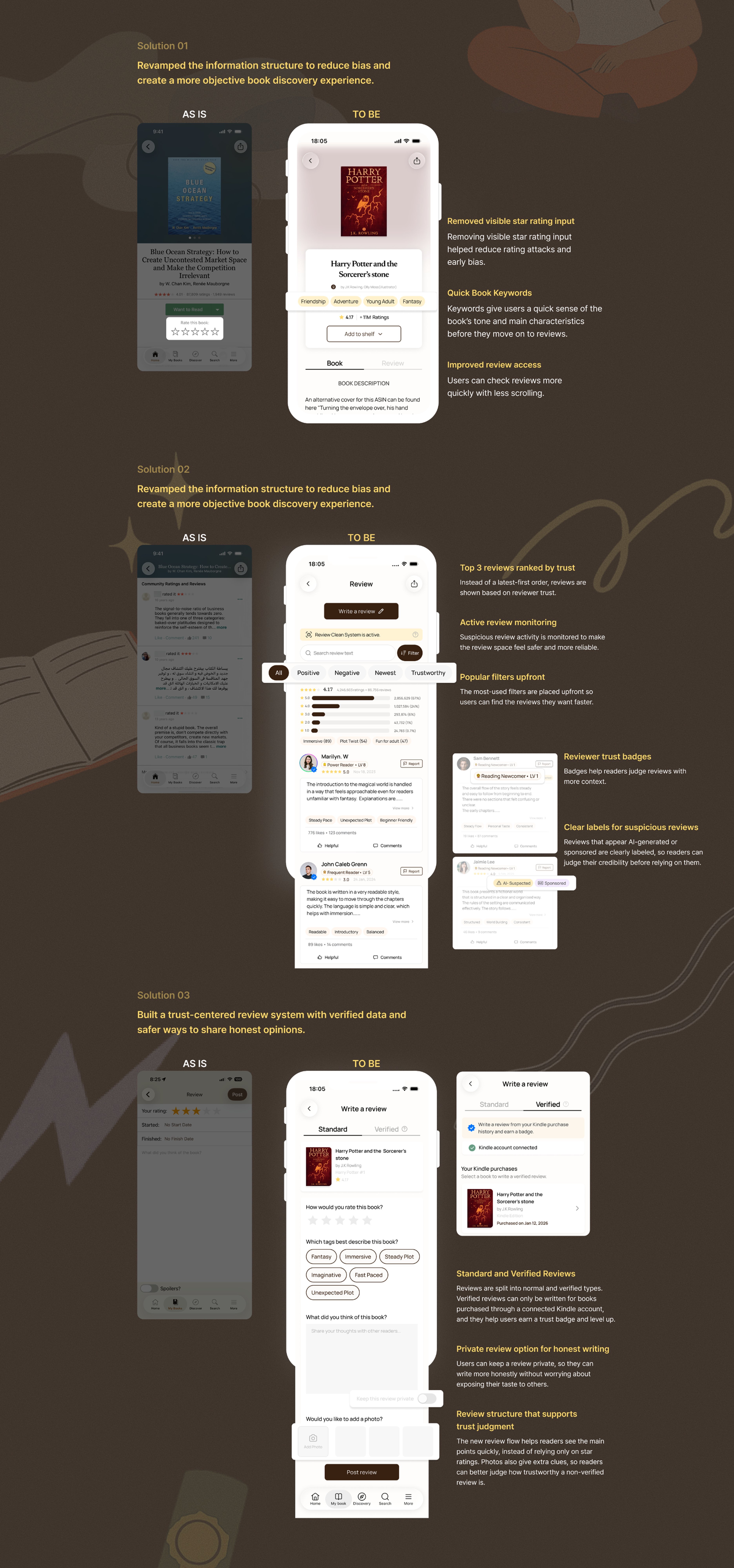
Book Explore is designed to reduce early influence from ratings and popular opinions. Users first explore the book’s core information, then review different perspectives through signals such as Newest, Trustworthy, Positive, and Negative. This helps them form their own impression before using reviews as supporting evidence.
2. REVIEWER EXPLORE
Helping users judge reviews with reviewer context
Reviewer Explore helps users judge whether a review is relevant and reliable by showing who wrote it. Instead of relying only on the newest or most popular reviews, users can check reviewer details such as verified purchase, reading history, rating patterns, and previous reviews. This helps readers decide whether the reviewer’s perspective matches what they need.
3. WRITE A REVIEW
Separating Standard and Verified Reviews
Write a Review lets users leave either a Standard Review or a Verified Review. Users can still share their thoughts on any book, while reviews linked to Kindle purchase history are marked as Verified. This helps readers understand which reviews come from confirmed purchases and supports a more trustworthy review system for Goodreads.
DESK RESEARCH
Why Goodreads Reviews No Longer Feel Trustworthy
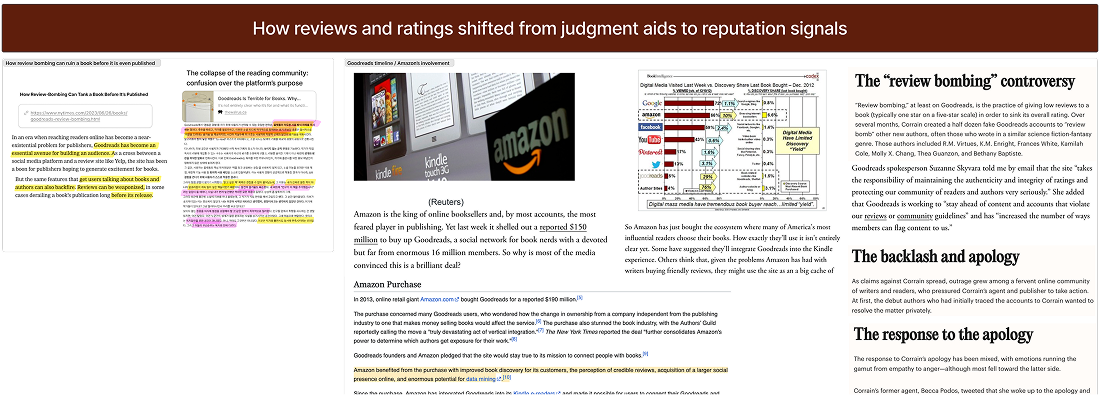
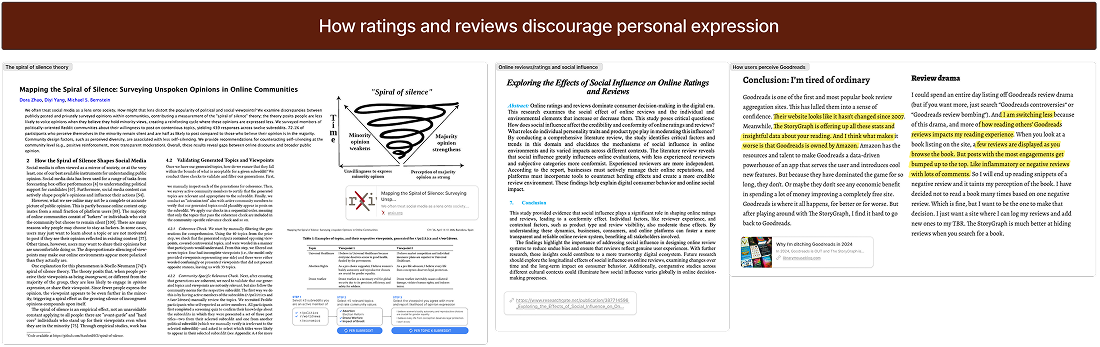
I conducted desk research and found that Goodreads’ review system had become less trustworthy. Readers were often exposed to unverified ratings and strong public opinions before forming their own judgment, which seemed to affect both trust in reviews and honest expression.
Insight 01.
Why readers originally came to Goodreads?
Goodreads was originally a reader-centred platform where people could discover books, track their reading, and use reviews to decide if a book was right for them.
Insight 02.
How Broken Trust is Driving Users Away
Following the Amazon acquisition, the platform’s focus shifted and left the review system open to manipulation. Goodreads lost its most valuable asset of trust because fake ratings went unchecked. This loss of credibility has caused constant frustration for users and pushed once-loyal readers to seek alternatives.
Insight 03.
How ratings and reviews discourage personal expression
The current system shows popular reviews too early, making some users less willing to share their own honest thoughts. This reduces diversity and weakens the quality of reviews.
1:1 IN-DEPTH INTERVIEW
Decision Was Shaped Before Book Exploration
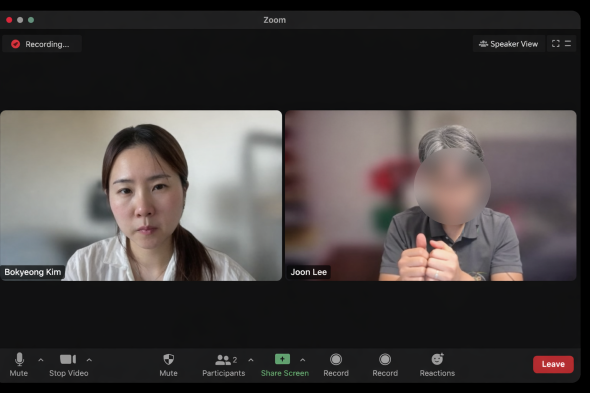
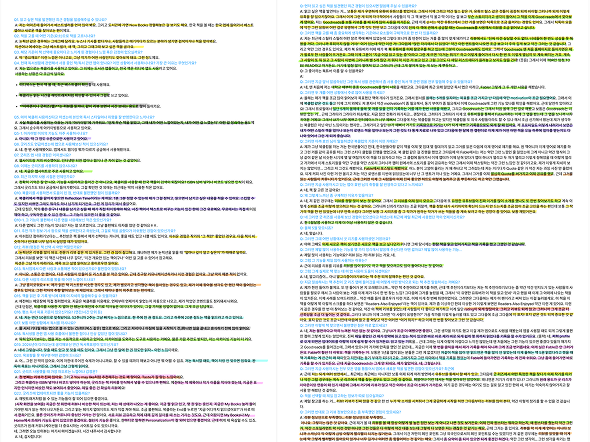
We interviewed two participants who use multiple reading apps to understand how they choose books and use reviews. On Goodreads, ratings, review volume, and other readers’ reactions often shaped users decisions before they even explored the book itself.
User Interview with Participant 1
Insight 01
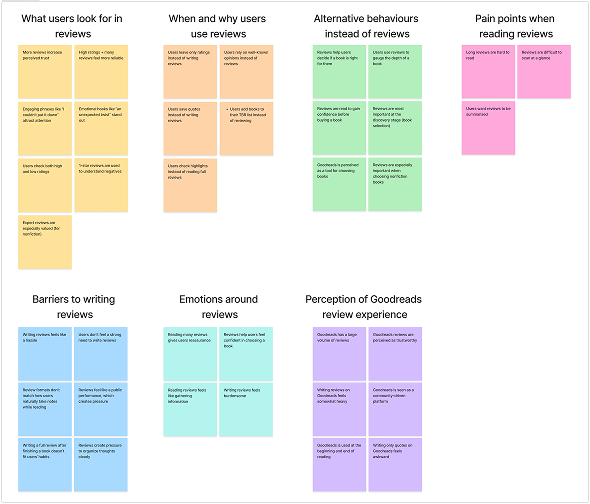
Users trusted books more when they had many ratings and reviews.
More reviews and higher ratings made the book feel more trustworthy.
Insight 02
Ratings and reviews are used to feel sure about a book choice, not to learn about the book
Users looked at reviews to judge the book’s quality and to decide whether they could trust it before choosing it.
Insight 03
Top ratings and reviews shaped first impressions before users even looked at the book.
Users were influenced by top ratings and strong review phrases before they even read about the book. They looked at other people’s reactions first.
COMPETITOR ANALYSIS
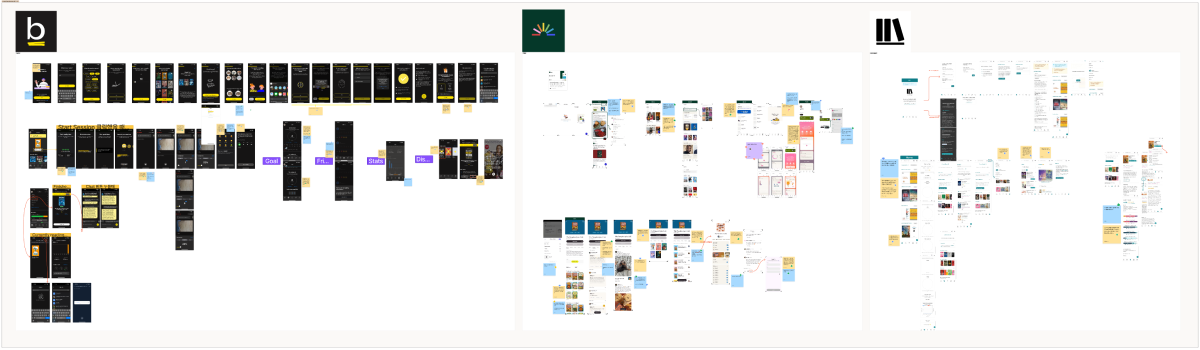
How Other Platforms Shape the Review Flow
We analysed other platforms to understand how rating and review flows are structured, focusing on when users rate and how reviews are written and consumed. This helped us understand how different platforms shape the review experience.
Competitive Analysis
Insight
Across platforms, reviews are shaped by others’ opinions or used mainly for personal tracking, not for helping users judge trust.
PROBLEM STATEMENT
Goodreads is losing user trust as review bombing and promotional reviews weaken its role as a trusted book discovery platform, putting its reputation and competitiveness at risk.
PERSONA & USER JOURNEY MAP
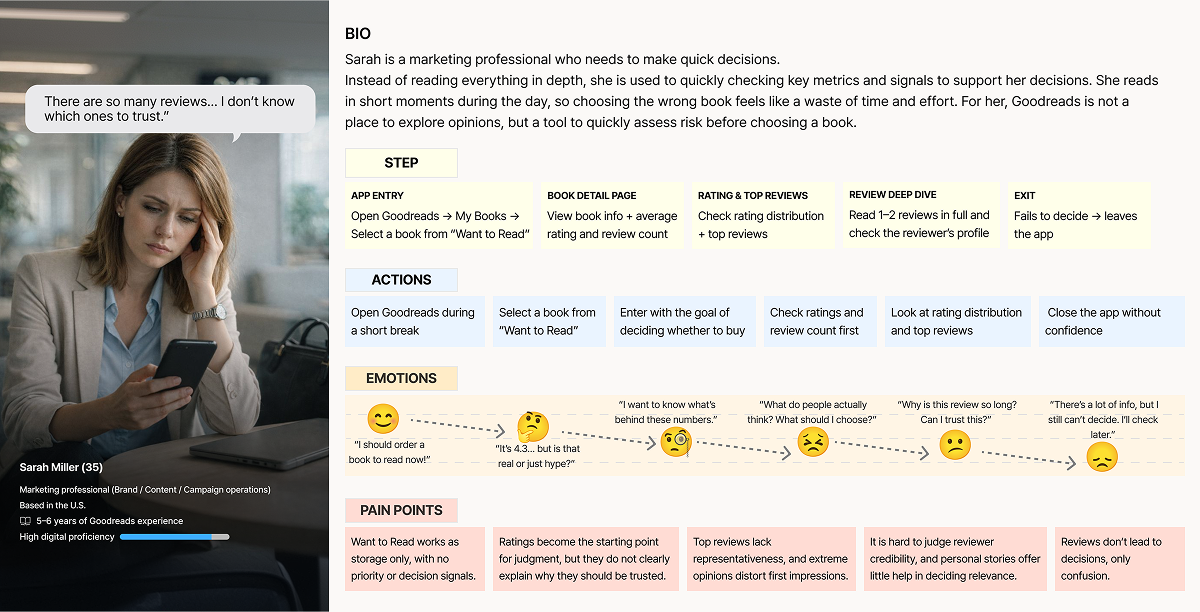
Defining a Persona Around Review Trust
Research showed that Goodreads reviews shape first impressions more than decisions. Most platforms let users read and write reviews, but don’t help them judge what to trust. So we defined a persona who needs to quickly find trustworthy reviews and decide with confidence.
STORYBOARD
Understanding the Review Decision Experience
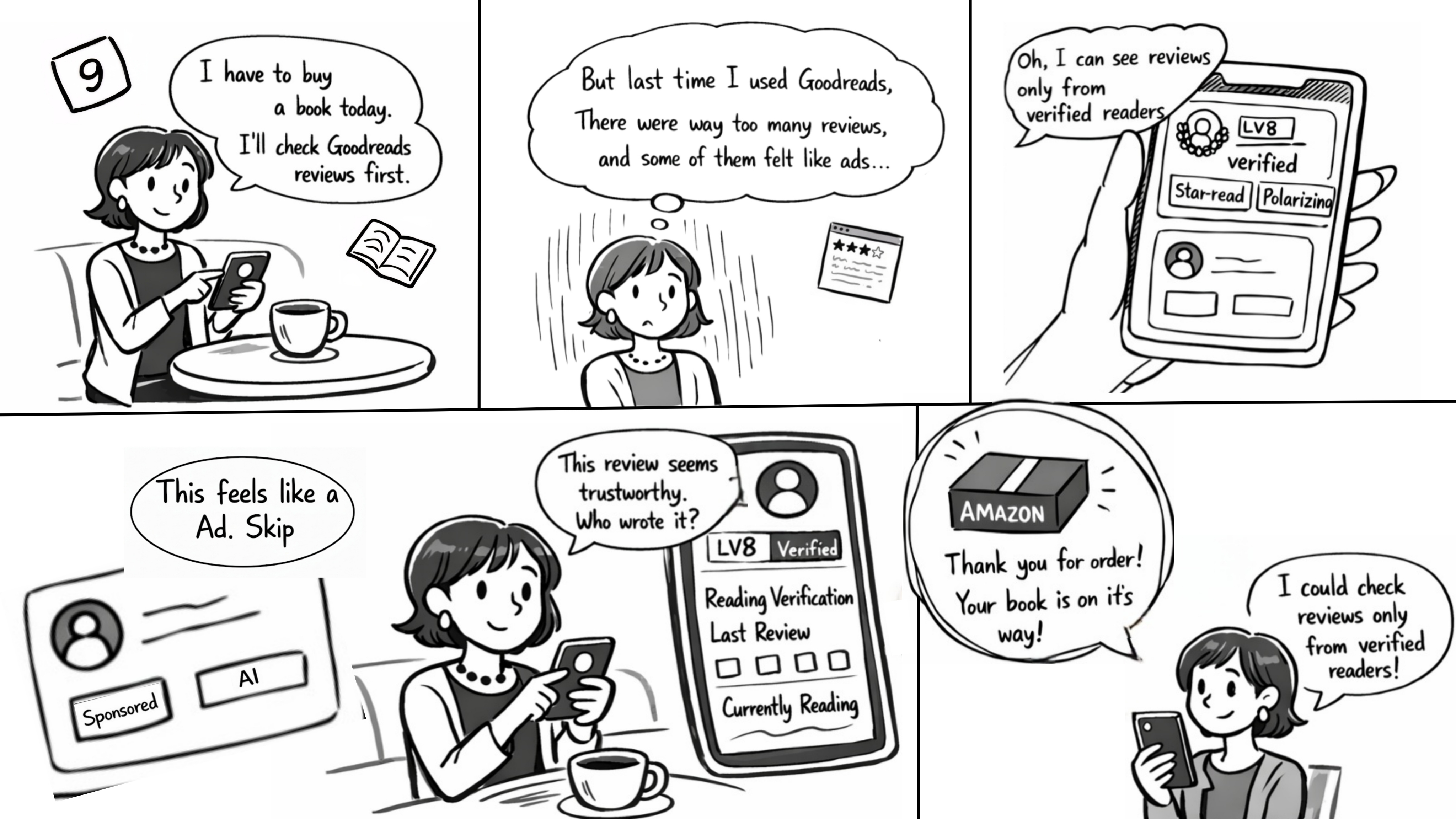
This storyboard illustrates how users rely on reviews to make decisions, but struggle to know which opinions to trust.
 It reveals how exposure to overwhelming and unverified reviews leads to hesitation instead of confident action.
HOW MIGHT WE
How might we help users quickly find reviews they could find trustworthy?
2x2 MATRIX & CRAZY 8
How We Developed Solution Ideas
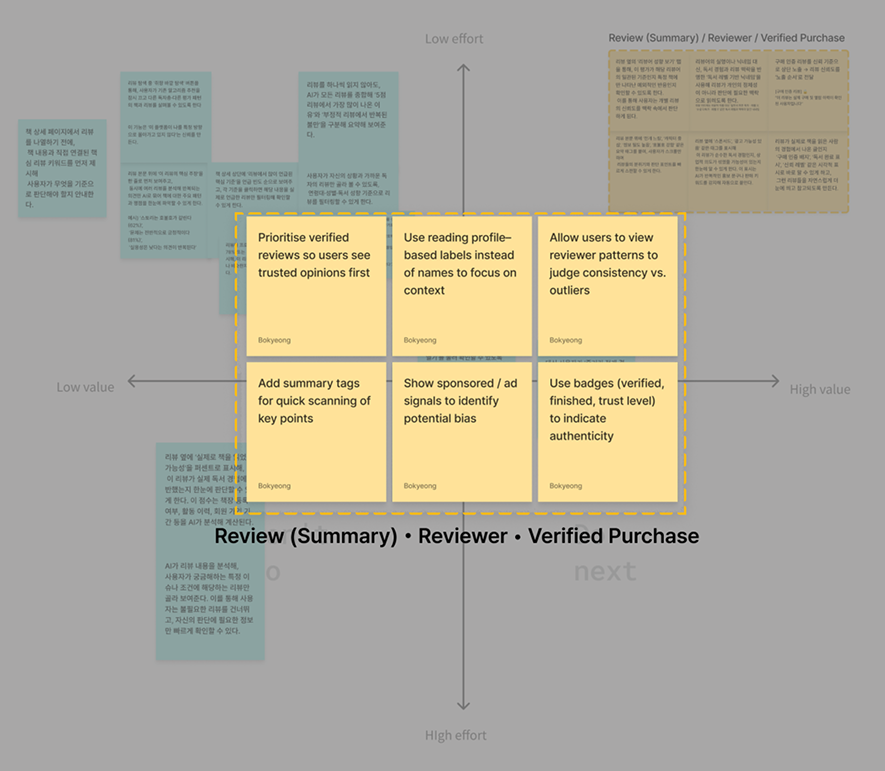
To explore possible solutions, we translated key insights into How Might We questions, prioritised ideas using a 2×2 matrix, and generated a wide range of concepts through Crazy 8s.
Crazy 8’s
How might we & 2x2 Matrix
IDEA SKETCH
Turning Selected Ideas into Screen Sketches
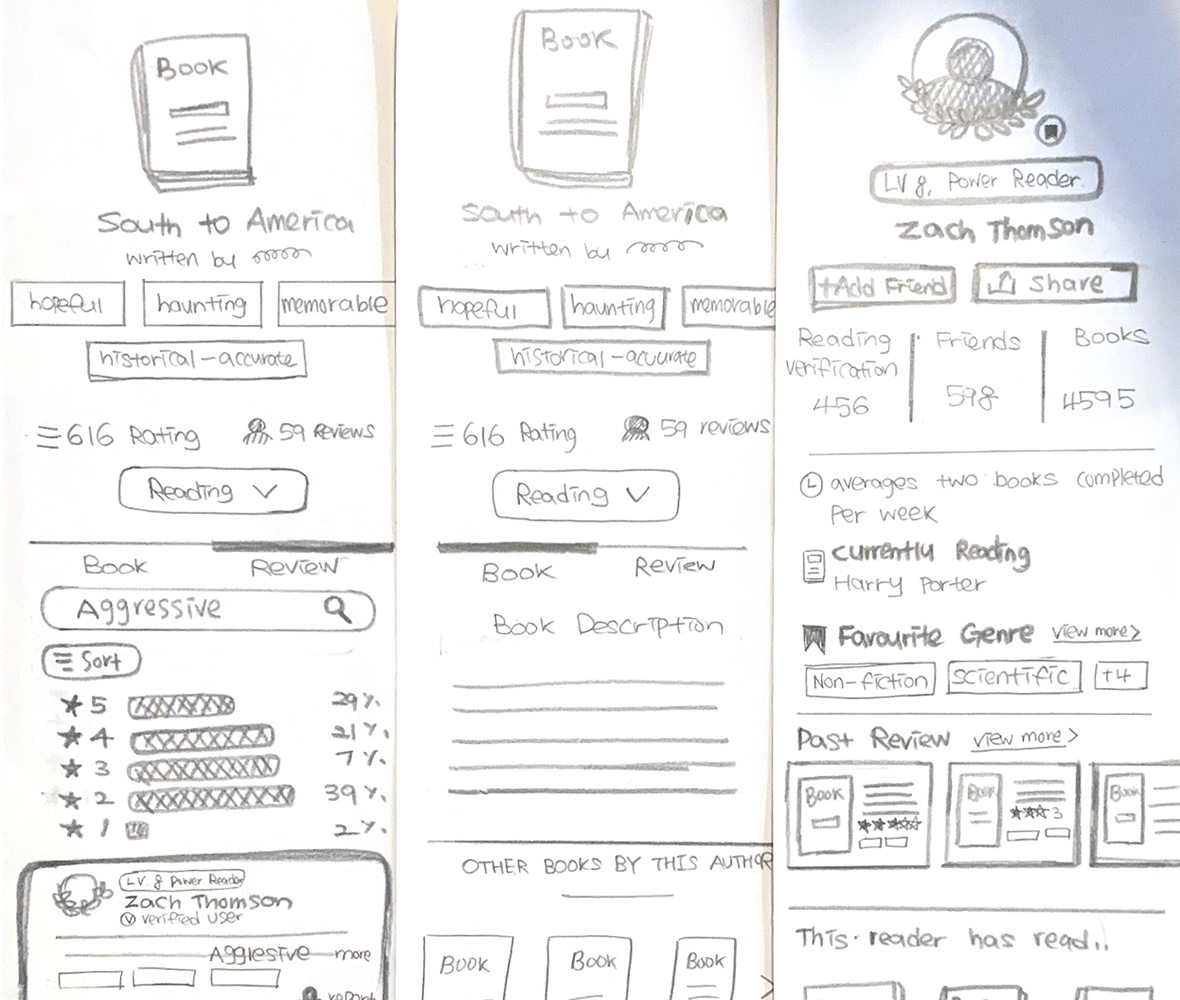
Based on the key ideas selected from the 2×2 matrix, I created early screen sketches to check the screen flow and structure, and to define the main features and user flow in more detail.
Crazy 8’s
Idea Sketch
WIRE FRAME & FLOW
Structuring the Review Trust Flow
To define the flow from review exploration to review verification, we developed a wire flow. This helped structure how users quickly scan key information and evaluate which reviews they can trust
Mid-fidelity wireframe
USABILITY TESTING / SUS EVALUATION
How the redesigned review experience helps users make better judgments
We conducted a usability test with five participants to evaluate whether the redesigned review experience helped users quickly understand reviews, judge their trustworthiness, and choose books with more confidence. I also used the SUS questionnaire to measure perceived usability and compared it with participants’ observed behaviours and verbal feedback.
User testing with Participant 4
Insight 01
The average SUS score was 81, but trust judgment lowered the score.
Scanning reviews was relatively easy, but the experience became more difficult when users had to interpret reviewer information and trust signals.
Insight 02
Lower-scoring participants needed extra checking before making a decision.
The top-level information was visible, but it was not always clear which signals they should trust, which interrupted the flow of quick decision making.
Insight 03
Higher-scoring participants made decisions more confidently.
This suggests that the score gap was shaped less by screen comprehension and more by how naturally each participant could use the information structure as a basis for judgment.
VISUAL DESIGN SYSTEM
Designing a consistent visual language across the redesign
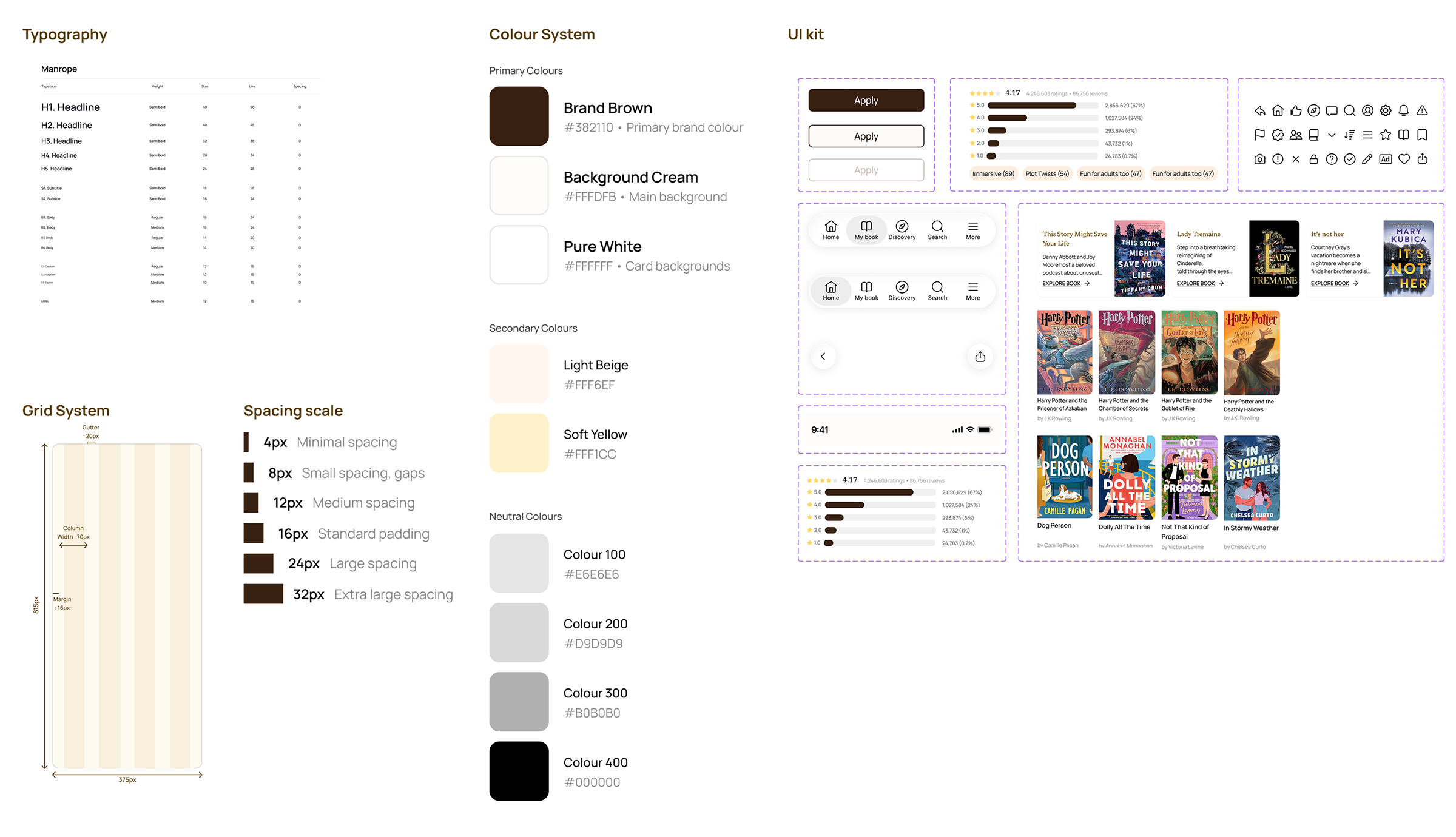
I created a visual style guide to keep the redesign consistent across colours, typography, buttons, and review cards.
TAKEAWAY 01
Review Trust Helps Users Choose Books and Protects Goodreads’ Platform Value
I learned that trust comes from context, not just badges. By making reviewer habits and data sources more transparent, I helped users judge reviews with less uncertainty. This was not just a UI update, but a way to rebuild trust in review data and protect the platform’s long term value.
NEXT STEP
Refining the balance between Verified and Standard reviews through data-driven validation
My next step is to identify the optimal ratio between Verified and Standard reviews to ensure both credibility and content scale. I aim to evolve the sorting algorithm to maintain high data integrity while preserving the diversity of reader perspectives, ultimately driving long-term platform growth.
TAKEAWAY 02
Helping Users Choose Books by Their Own Standards Over Volume
Too many reviews were not the real problem. The issue was that popular opinions could overpower personal judgment. I revamped the information hierarchy so users could compare reviews by their own standards, helping them make better choices and supporting a healthier community.
EXPLORE MORE WORK